
AI in the boardroom
Masters in General Management students given two chatbots as sparring partners in Goldstein simulation



By Bjorn Cumps
Professor of Financial Services Innovation
A brewery is in dire financial straits. You’ve got four days to turn the tide. And for the first time: two AI chatbots as a sounding board. The Goldstein simulation was more than an induction exercise for our Masters in General Management students this year. It was also a good test of how AI can play a role in strategic decision-making.
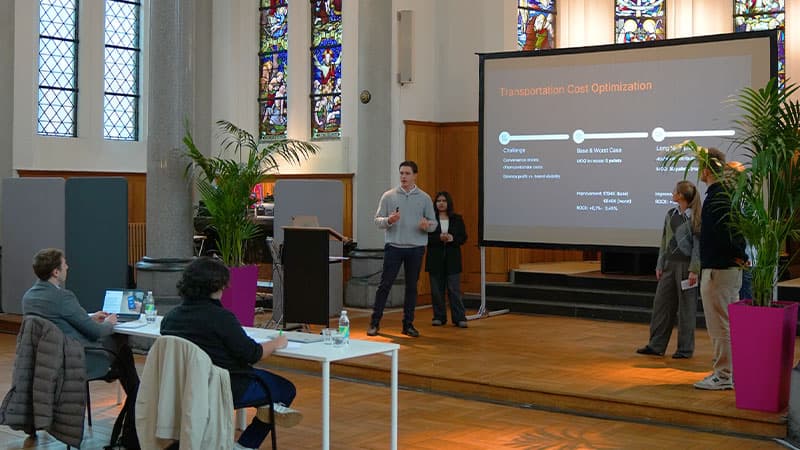
It’s a case study that really stresses our students out. And that’s not without cause. The Goldstein simulation, a four-day management exercise which Vlerick organises in partnership with PwC, throws Masters in General Management students right into the operational and financial chaos of a struggling brewery. There is no clear data and no easy answers; instead, just a mountain of information, tight deadlines and a boardroom you need to pitch your proposal to. This year, the students faced a new element thrown into the mix: two AI chatbots tailored to the case. “Not as a gadget, but as a genuine addition to the learning process”, explains Bjorn Cumps, Professor of Management Practice in Financial Services Innovation and Fintech, who coaches the case study.
Life on the ground: the consultant
The Goldstein Brewery is in dire straits, and management expects a tangible improvement within one hundred days. Growing inventory, shrinking margins and logistical inefficiencies: the problems are right there, but they’re hidden away in about forty pages of case material and a large data set from PwC. “The students can get completely lost in there”, Bjorn knows from experience. “And that’s where the challenge lies: in making choices in a sea of information.”
“That’s exactly what we do as consultants every day”, points out Lotte Van Doorsselaere, Commercial Excellence Advisor at PwC, who controls the simulation from PwC’s end. “You need to turn a gigantic amount of information into a very coherent, strategic narrative.”
AI chatbots: the junior data analyst and the Chief Commercial Officer
This year, Vlerick and PwC decided to enrich the simulation using two AI chatbots, each with its own role and personality. One is a junior data analyst: analytical and data-driven, it can be used for specific questions about figures and assumptions. The other is the brewery’s Chief Commercial Officer: more strategic in tone, with a broader business context. The two of them can be used to help the students on their way – without giving them the solution, of course.
“PwC has built the bots using their entire data set, but we tested and refined them together”, Bjorn clarifies. “What answers are the bots allowed to give? What aren’t they allowed to say? How do we ensure they stay within their role? How do we stop them from hallucinating outside the context of the case? It was a very iterative process of testing and adjusting.”
Maximum of three prompts
To keep the students on their toes, the organisers decided to limit the number of prompts per bot to three. That was a deliberate choice, Bjorn explains: “We wanted to force them to think carefully about which questions to ask. Which questions are actually the most valuable? The results were mixed: some teams really did think the case through in detail first, keeping their prompts as a strategic reserve. Others found out that they couldn’t get around the restriction by asking overly long, nested questions. Technically they were only giving one prompt, but actually there were fifteen questions in one. That didn’t work out all that well for them”, Bjorn remarks with a wink.
Masters in General Management student Lucas Van Daele and his team were the type who thought things through first. “We were convinced that we’d need them at the end for really important and difficult questions,” he laughs. “On the last day, we still had all our prompts. So we used them to check our assumptions: were they correct?”
Critical thinking as a key skill
What insights did the Goldstein simulations with the AI bots deliver? Bjorn’s suspicions were confirmed: “Students know exactly how to prompt, but they still don’t make sufficient use of an AI tool as a real sparring partner. Most of the students used their prompts for data analysis, although they might have done better to use one to prepare themselves for the board’s Q&A. I don’t want to see students simply using AI to make their own lives easier. They should be using it to make their lives more difficult.”
Lotte has seen the same attitude in rookie consultants at PwC: “Increasingly, we are finding that AI can give us speed with difficult questions, but it’s still important to reflect very critically. We are continuing to thoroughly stimulate that learning curve. This is something we also do intentionally during onboarding. We sometimes put deliberately incorrect output into assignments, just to see if they extract it. It’s great that Vlerick is on the same wavelength and that we are committing to this together.”
For the students themselves, the simulation was an exercise in something more difficult than it sounds: knowing when to use AI and when not to. Lucas Van Daele puts it succinctly: “AI is a tool to structure your decisions. It doesn’t replace your brain. The biggest lesson was maybe that good decisions seldom emerge from a single analysis, but rather from iteration, discussions between people with different backgrounds and a clear focus on assumptions.” That’s a lesson that extends far beyond the boardroom of Goldstein Brewery.
AI enhanced leap learningThe Goldstein simulation is one of the ways in which Vlerick is putting its vision on AI enhanced leap learning into practice. See also:
|
Get in touch!