
Belgian companies anticipate economic slowdown: priority for downsizing has tripled
Results of the 2026 HR Barometer


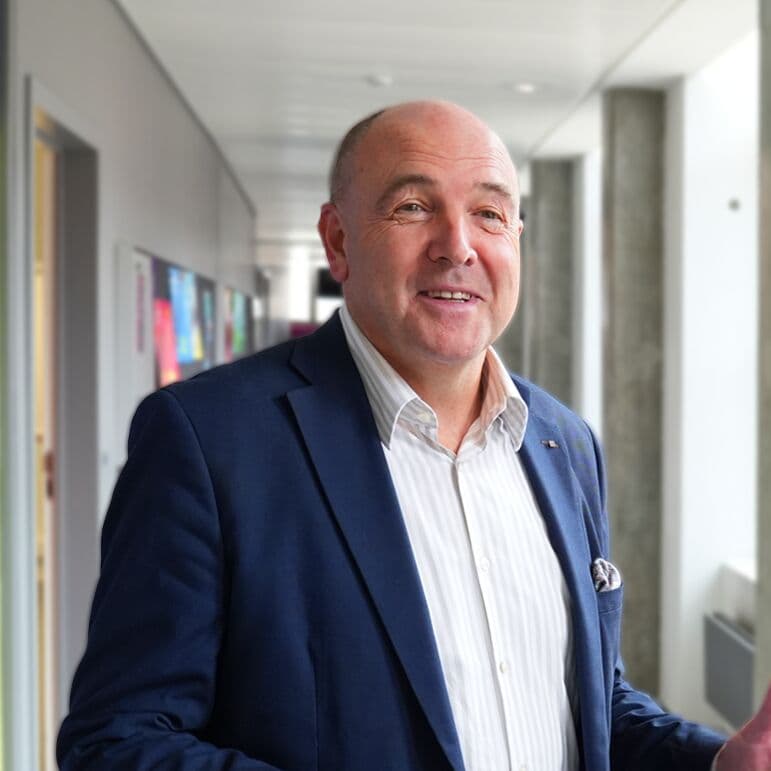
By Dirk Buyens
Professor of Human Resources Management

By Silke Van Gansbeke
Junior Researcher, People Management & Organisation
After years of unprecedented shortages on the labour market, Belgian organisations are preparing noticeably more often for an economic slowdown. The priority accorded to stagnation and downsizing increased by 28 percentage points over the past year. This is evident from the new (12th) edition of the HR Barometer, issued by Vlerick Business School and HR consultancy Hudson (part of Randstad). Despite this sharp increase, the study of 132 of the largest organisations in our country does not point to panic-driven decisions, but rather to a strategic shift in direction.

The paradox of 2026: preparing for shrinkage, investing in efficiency
The data indicates a turning point for the Belgian economy. The median score for the priority “Prepare for Stagnation/Downsizing” increased by 28 percentage points, from 15 to 43 out of 100. This is the highest level in six years, and it has almost tripled compared to 2025. All the same, this is not a collective emergency stop. Downsizing currently remains the second lowest priority on the overall strategic agenda.
However, the business world is divided: while the theme is still barely relevant for 40% of the organisations (score below 20), almost a quarter (24%) give an alarm score of over 80. These scores are 14 percentage points lower and 14 percentage points higher, respectively, than last year. This need for restructuring is currently felt most acutely in the Retail, Chemical and Industry & Manufacturing sectors.
The shift to precision HR: data first
The macroeconomic slowdown is reflected directly in recruitment policy. For the first time since the Covid-19 pandemic, the priority for Recruitment & Selection has dropped sharply to a median of 65 (from a peak of 85 in 2022). The Learning & Development (L&D) budget is also under pressure, with a decrease to a score of 61 (compared to 75 last year).
The most striking finding, however, is that companies anticipating contraction are not simply making indiscriminate cuts. There is a strategic shift to “smart” HR tools:
- HR Analytics: decisions about the workforce are more often made in a data-driven manner.
- Operational Excellence: the focus is shifting to the more efficient use of current resources.
- Industrial Relations: companies are investing proactively in the relationship with social partners to ensure that transitions run smoothly.
Digitalisation remains unaffected
Despite the current economic uncertainty, companies are continuing to invest in making progress with their digital transformation. Whether a company expects to grow or contract, the adoption of technology continues unabated. Digitalisation is no longer seen as a variable cost, but as an absolute prerequisite for survival.
“The labour market is normalising after a period of extreme overheating,” says Ellen Volckaert, Senior Business Manager R&D at Hudson, part of Randstad. “The focus is necessarily shifting from quantity to quality and retention. In an uncertain market, in which talent is also less mobile, it becomes even more crucial for employers to invest in strong leadership, internal mobility and strategic workforce planning. We are seeing a shift from ‘growth at all costs’ to ‘operational efficiency.’ Although companies are building in buffers, recruitment and development are continuing at a slower and more realistic pace.”
Professor Dirk Buyens (Vlerick Business School) adds: “It is striking that Belgian organisations today are responding much more maturely to an impending slowdown than in previous crises. Instead of a blind cost-cutting drive, we are seeing a shift toward precision HR. Companies are hiring more selectively and using data and strong social dialogue to keep the existing organisation fundamentally healthy. The fact that digital transformation is continuing unabated shows that technology is now regarded as an indispensable constant, regardless of economic conditions.”
About the HR Barometer
The HR Barometer is a research project initiated by the Vlerick Strategic Talent Management Centre at Vlerick Business School. This expertise network focuses on knowledge building and sharing within HR and Talent Management. Along with 30+ member organisations from various sectors, the research centre keeps a finger on the pulse of effective HR practices and relevant developments in the field.
About Hudson
Hudson helps organisations and their employees – experts, executives and business leaders alike – to develop and express their full potential. We offer specialised solutions in permanent recruitment, talent management (assessment centres, coaching & development, salary surveys, job classifications, etc.), interim management and HR tools. The latter were developed by our own internationally renowned R&D department. Our HR solutions are not only aimed at companies that want to get the best out of their employees, but also at professionals who are looking for a reliable HR partner to support them in their career development. Hudson’s services guarantee high added value at all stages of the HR life cycle. With clients ranging from SMEs to multinationals, both in the private and public sectors, our company has built a reputation for professionalism and excellence in HR consultancy for more than 40 years. Hudson has formed part of Randstad Group Belgium since December 2021.
Get in touch!