
From the pitch to a broader leadership perspective
In the media


How do you grow as a leader in a fast-evolving and complex industry like professional football?
For Vlerick alumnus Dries Van Meirhaeghe, the answer lies in expanding his perspective beyond the pitch. In a recent article by the Financial Times, he shares how an MBA is helping him navigate the business, strategic and organisational realities of modern football.
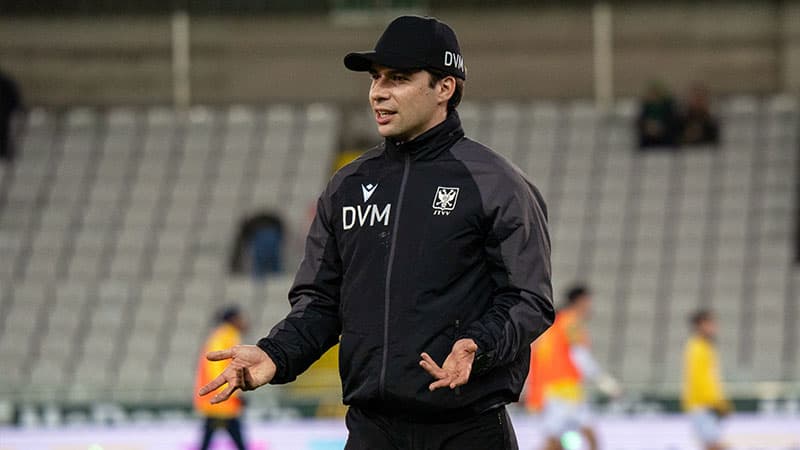
As a football coach, what specific gaps in your knowledge or decision-making made you feel an MBA was necessary? And why an online one?
“Apart from my wish to deepen my skills in entrepreneurship, I mainly felt that there is a structural educational gap in football.
As a coach, you are educated almost exclusively on the sporting side: tactics, methodology, performance and psychology. But there are fewer pathways that prepare you for broader leadership roles inside a club, such as sporting director, academy director or executive functions. Until very recently, there was not even a sporting director course in Belgium. The first edition only started this year at the Royal Belgian FA, which I am currently participating in.
At the same time, modern football clubs have become complex organisations. They operate as medium-sized companies with multiple departments, financial pressures, infrastructure projects, community responsibilities and increasingly sophisticated ownership structures. I realised that if I want to grow inside this ecosystem, I need to understand more than just the pitch.

I strongly believe that the future leaders in football will be people who understand both the business side and the specific dynamics of the game. You see this reflected in successful clubs across Europe. Atalanta, for example, is led by the Percassi family, who built their fortune in retail and real estate. Antonio Percassi is a retailer and entrepreneur, his son Luca is CEO with a strong business profile, and later Stephen Pagliuca, a private equity investor, joined as co-owner. They combined entrepreneurial thinking with football expertise, and that mix is a big reason behind Atalanta’s long-term rise.
Given the reality of a coach’s life - irregular schedules, travel, and the fact that changing clubs is not unusual - an online MBA was the only realistic option. It allows me to combine high-performance coaching with continuous education, independent of location. As a coach, you often only know a few days in advance whether you can attend a meeting or even stay in the same country, which makes traditional, fixed schedules almost impossible. The flexibility of an online programme means I can adapt around study breaks, international moves and constantly shifting timetables, while still committing fully to the academic work.”
What has surprised you most about how business frameworks differ from, or resemble, what you do in football?
“In football, results are judged on a very short-term basis. Emotions have a huge impact on daily operations. External pressure from fans, media and stakeholders influences decision-making much more than in most industries. That makes sense, because football is built on identity, community and winning, but it also explains why clubs sometimes struggle to be stable and profitable at the same time.
What has been refreshing through the MBA is learning how other industries define and measure success. Many organisations focus much more on long-term indicators: sustainability, customer value, employee development and scalability. More football teams are also starting to use these types of indicators to guide decision-making, not only match results.
I do believe football is slowly moving in that direction as well. More clubs are redefining success through long-term KPIs such as player development, player sales, community engagement and infrastructure, linked to the ambition of being competitive on the pitch.
Clubs like Union Saint-Gilloise, led by Alex Muzio (private equity), Club Brugge with Bart Verhaeghe (real estate), Brentford, owned by Matthew Benham (data entrepreneur), and Atalanta with the Percassi family (retail), all show that when clubs are built as well-run organisations first, sporting success follows.
Through the MBA, I became more convinced that leading a football club should start with creating a clear framework and direction. If the process is right, results become a byproduct. But beyond frameworks, you also need a culture where people are truly invested and aligned. Football is driven by passion, and without coherent teamwork and shared purpose, like any business, even the best strategy will fail.”
How has studying an online MBA alongside coaching changed the way you make decisions in real time?
“The biggest change is perspective. I still approach training, tactics and match preparation as a coach. But around those decisions, I now think much more about the broader context of the club as a business.
Understanding financial structures, cost drivers, revenue models and organisational design influences how you look at recruitment, player development and squad planning. For example, in Belgium, transfer income is essential to be profitable. That means players are not only sporting assets, but also financial assets. Their value is influenced by age, playing time, position, development trajectory and exposure. That has consequences for how you build development plans, how you rotate players and how you think about squad composition.

The MBA has been less about changing one tactical decision, and more about reshaping how I see the entire structure of football. You begin to think in terms of financial strategy and long-term value creation, which inevitably influences which player profiles you prioritise and how you plan their development from both a sporting and monetisation perspective.
The MBA has also made me more aware of the importance of culture, leadership and HR. These are topics that are central in business education but rarely addressed in coach education, even though they are crucial in football.
In practical terms, it allows me to have better conversations with different departments inside a club: recruitment, data, performance, operations and finance. I understand their language better, and that improves alignment.
So the biggest impact is not one specific decision, but a more holistic way of thinking about my role.”
Do you see the MBA as enhancing your career within football, or as a bridge beyond it?
“Within football, I see it as an opportunity to grow into roles such as academy director, sporting director or other executive functions. But I also believe it can strengthen my profile as a future head coach.
A head coach today is not only a tactician. A big part of the job is leading people, managing staff, shaping culture and understanding the business framework of the club. If a head coach can align with, understand and even influence the strategic direction of a club, that is how you create long-term success.
You see this with coaches who shape a club’s identity over many years, such as Pep Guardiola at Manchester City and Diego Simeone at Atlético Madrid. But you also see it in smaller contexts, such as Kjetil Knutsen at Bodø/Glimt or Christian Ilzer at Sturm Graz. They show that strategic alignment and culture-building are not luxuries reserved for big clubs.”
Beyond clubs themselves, football is a rapidly evolving industry. Data, technology and innovation are changing recruitment, talent development, match preparation and fan engagement.
You see this in different layers of the game. There are innovative data analysis software solutions that optimise recruitment processes through the combination of event data and physical data, such as the Belgian start-up MyGamePlan. At the same time, multiple clubs have started building in-house data teams that analyse fan behaviour on match days to improve engagement, pricing strategies and the stadium experience.
Together with other coaches, I co-founded Athlete ID, a company focused on optimising talent detection by lowering the threshold for performance testing in youth footballers outside professional academies. We already have cases where players received trials at professional academies after being identified through our platform, whereas traditional scouting had not picked them up.
In that sense, the MBA helps me not only as a coach, but also as an entrepreneur who wants to contribute to the future of football. I am completely passionate about the game, but the game itself is evolving at an incredible pace. Only ten years ago, data was not embedded in daily football operations the way it is today. There has been massive innovation in imaging, analytics and technology investment and if you want to stay relevant, you need the tools to understand and shape that change.
I do not see it as a bridge beyond football, which is both my passion and my career, but I do see it as a bridge to the future of football and the direction the game is heading."