
Your organisation is on a journey… but are you building the right skills to reach your destination?


By Karlien Vanderheyden
Professor of Organisational Behaviour
By Dirk Buyens
Professor of Human Resources Management

By Ignace Decroix
Doctoral Researcher, Digital Transformation

By Silke Van Gansbeke
Junior Researcher, People Management & Organisation
By 2030, nearly two in five of the skills your people use today will either have changed significantly – or become obsolete. This is the major takeaway from the World Economic Forum’s 2025 Future of Jobs Report1. It’s a statistic that can make organisations rush to refresh their training programme – typically by adding a few new courses on trending topics like AI. This, they hope, will allow their employees to keep pace.
The same report includes an even more significant figure. A total of 63% of employers believe the single biggest barrier to business transformation is not capital, technology or regulation – but a skills gap.
How can this be, when many organisations are training their teams regularly?
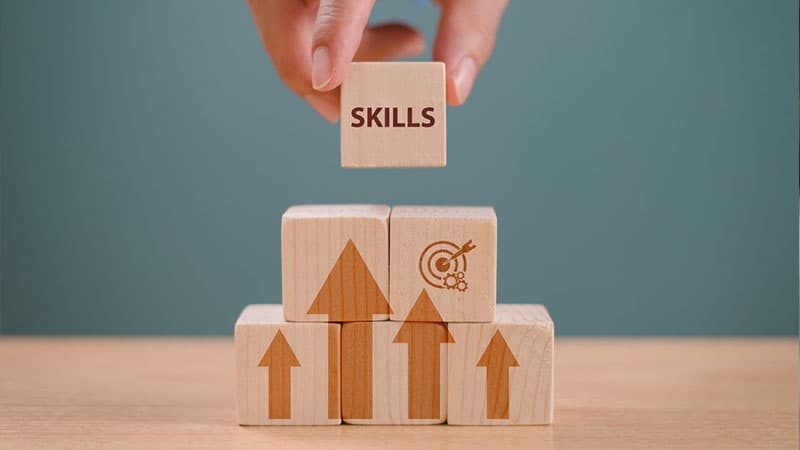
In many organisations, lack of training opportunities isn’t the problem. In fact, training programmes can be packed – and yet still not help organisations to get the results they’re looking for.
The reason for this is that busy training schedules can hide capability gaps. People may be working hard, but not learning the skills their organisations need to move in a new direction.
So we’ve developed the Skills of the Future Model to help organisations address this barrier. It helps them to align training with strategic goals – and create clarity about the direction they want to take.
Four journeys, one direction
The Skills of the Future model gives organisations a clear way of upskilling in ways that lead to growth. And because it’s all about nurturing and growing, we encourage leaders to think of capabilities as leaves on a healthy plant.
The model starts with a question: What kind of organisation do you want to be?
Typically, there are four routes (leaves) your organisation could set out on. And each route involves developing three sets of skills…
Digital journey Skills to build: Collaboration between human and machine, digital appetite and capacity for innovation | Service journey Skills to build: Problem solving, co-creation and negotiating for value |
Caring journey Skills to build: Building trust, DE&I sensitivity and authenticity | Performance journey Skills to build: Team effectiveness, motivating others, and giving and seeking feedback |

Of course, these routes aren’t mutually exclusive. But organisations that try to take all four at the same time can struggle to achieve growth. If you find that progress stalls – or you don’t get the results you were expecting – then it’s likely that your organisation is taking training routes that don’t align with your strategic goals.
Defining your route up front makes is easier to see any disconnect between the skills you’re planning to train and the destination you want to reach.
The right mindsets to feed the soil
It’s also important to remember that strategy and direction alone do not grow capability. If you want new skills to take root, you need to nurture the right culture around them. This is where our model’s three mindsets – the fertiliser, if you will – come in…
Systemic mindset You know that every action ripples outward – so your teams consider multiple perspectives and interactions. | Explorer mindset You empower your teams to be curious, learn and take considered risks. | Impact mindset You know every action has consequences – so your people aim for the most positive consequences every time. |

If you invest in skills – but fail to cultivate the mindsets to underpin them – you may find it difficult to sustain growth.
Now’s the time to review your approach to skill building
By 2030, 59 of every 100 employees will need new skills. So, the question is not whether your organisation should invest in building skills. It’s whether you’re investing in the skills that will help you get where you want to be.
The Skills of the Future model goes beyond asking: What skills do we need? Instead, it asks: What are we trying to become – and what skills and mindsets do we need to get there? Because building real capability is not about simply adding more training. It’s about making sure that every time you invest in your people, you’re moving your organisation forward – in the right direction.
Learn more
The Skills of the Future Model features in the new book, Make Talent Work: Unravel the 6 B’s on Talent Management in Your Company, by Prof. dr. Dirk Buyens, Prof. dr. Koen Dewettinck, Silke Van Gansbeke, Jana Machtelinckx, Valérie Legrand and Sarah Quataert.
It shares practical frameworks for making strategic talent decisions – covering everything from attracting and development through to retention and deployment.
Make Talent Work is available to buy here. We’d also love to welcome you to the book launch on 19 October.
Interested in joining one of our Human Resources Management programmes? Find the overview of our programmes here or discover our offer for companies.
Get in touch!