
“The employee with the best technical qualifications is not necessarily the best manager”


Dentist Christophe Heinix’s ambitions always extended beyond a single dental chair. He established his own practice in 2003, followed by a second a few years later. There were plans for a third, but the day-to-day running of the practices always seemed to get in the way. SME Excellence gave him the perspective he needed. “I wanted to professionalise, but that’s not something you learn in dental school.”
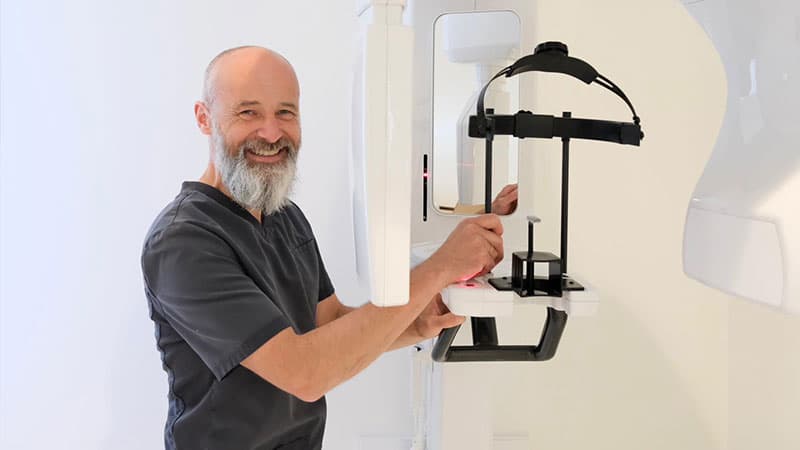
About Heinix
- Multidisciplinary healthcare centre comprising two dental practices, a sports medicine practice and a mobile dental practice serving residential care homes.
- Based in Antwerp and Edegem, Belgium
- Founded in 2003
- Over 25 employees
Why did you choose SME Excellence?
“The dental profession has a long tradition in my family. My grandfather started out in 1954 as one of the first dental technicians in Antwerp, my father had his own practice, and I myself graduated as a dentist in 1999. But it soon became clear that I wanted to put my own stamp on things. I really didn’t want to work alone and spend my entire life at the dental chair. After working for a time in a group practice in the Netherlands, I founded my own group practice in Antwerp in 2003. We started with just two chairs, but the practice grew steadily. By last year, we had two practices and nine chairs, and we were fully engaged in setting up a sports medicine practice. All very exciting, but at the same time I felt overwhelmed. My day-to-day responsibilities had become so extensive – from chasing up payments to carrying out recruitment procedures – that I no longer had the time or energy for what I considered the most important task: shaping the future of my business and reflecting on our mission. I wanted to professionalise, but that’s not something you learn in dental school.”
What are the main insights you gained from the training programme? Have they helped to resolve your challenges?
“Fairly early on in the programme, in the strategy module, I learned the most valuable lesson of all: in a growing business, it is essential to work on your business as well as just in your business. Although that might sound obvious, for me it was anything but. I thought I was doing well because I was working hard. But all those operational tasks were depriving me of something crucial: time. Time to think about processes that could make us more efficient, and time to reflect on our company’s value proposition and identity.
Very concretely, we are a classic example of client intimacy: our business model is built around bespoke service and long-term client relationships. Taking the time to examine this during the programme made me realise that many of our past decisions actually leaned more towards product excellence. For example, we placed a strong emphasis on online appointment booking because we considered it more efficient, but it’s not necessarily what our clients want.”
The question, of course, is how you actually make time for that kind of necessary reflection. I had assumed the programme would focus mainly on finance, but the most valuable sessions turned out to revolve around people management. Dentistry is a people-centred profession. Every chair requires a skilled professional, and you work in extremely close proximity to one another. So if I wanted to delegate more responsibilities, I needed to think much more carefully about management. That meant gaining insights into the different communication styles of my team members, putting a solid feedback system in place and – above all – giving people real ownership of their responsibilities.”
How have you implemented these insights?
“We now take our patients’ perspective much more into account when making decisions. For example, take the layout of the practice spaces in our new project. We’re designing them with two separate reception desks: one to welcome patients, and another for the more transactional aspects such as payments and scheduling follow-up appointments. It’s slightly less efficient and requires more space, but it’s what makes our patients happier.”
“On top of that, I now invest far more in management. Just before I started the programme, I had appointed a new team manager – the best dental assistant on the team, truly excellent at her job. But the employee with the best technical skills is not necessarily the best manager. Once I began applying the management tools from the programme, that quickly became clear in our own organisation as well. The new manager was someone with a yellow communication style: she was relationship-oriented rather than task-oriented. It turned out not to be a good match. This became clear six months later, when she herself admitted that the role was too demanding for her. For her successor, we brought in a consultant: someone who helped define her leadership approach, worked out with us how to ensure the different team profiles were a good fit, and provides ongoing practical support with regular conversations.”
“I’ve also adapted my own leadership style. I no longer tell employees what to do, but rather why it needs to be done. How they choose to approach it is up to them. That has been a real eye-opener for me: when you give people ownership, they naturally take on more responsibility.”
What impact have these steps had on your business?
“In the past, employees were always asking me what needed to be done, but they’ve stopped doing that. Everyone knows their role now, and that has greatly improved collaboration. Take hygiene, for example. Although I consider a strict hygiene protocol extremely important, I was wasting a lot of time constantly correcting colleagues. Things like: careful – you can’t touch the cupboard with those dirty gloves! After the programme, I delegated that responsibility to one of the team members, who came up with their own very creative solutions, such as putting up funny reminders.”
“Because I no longer have to concern myself with these relatively minor operational matters, I have more time to focus on strategy. For example, I’ve just signed the preliminary agreement for a large practice – our fourth – that will serve as our flagship, and we recently launched Amaryllis, a mobile service designed to make oral healthcare more accessible to residents in care homes. Although those plans already existed, thanks to SME Excellence I’m now approaching them in a much more structured way, with a clear long-term objective. For instance, I now reserve one day a week for meetings with stakeholders related to Amaryllis, in order to build broad support for the initiative.”
“I’m so convinced of the added value SME Excellence offers for our sector that, together with Vlerick, I have helped develop a new programme: SME Excellence for ambitious dental practices. Dental training is highly technical, with only a small component devoted to dealing with patients. But let’s be honest, anyone running a group practice is actually managing a complex SME. I never really stopped to think about that in the past. But the recognition, knowledge and tools I gained from the programme have only strengthened my entrepreneurial drive. I would like all of my colleagues to have access to that.”