
From raw factory data to smarter maintenance
A first GenAI hackathon with full-time MBA students and NMLK Europe turns real data into practical learning and a way to find business value.


By Martin Butler
Professor of Management Practice
How can Generative AI (GenAI) help reliability engineers to spot issues earlier and reduce downtime? As part of Vlerick’s full-time MBA programme, students teamed up with NLMK Europe for a hackathon that turned unprocessed maintenance logs into an actionable GenAI concept with clear next steps.
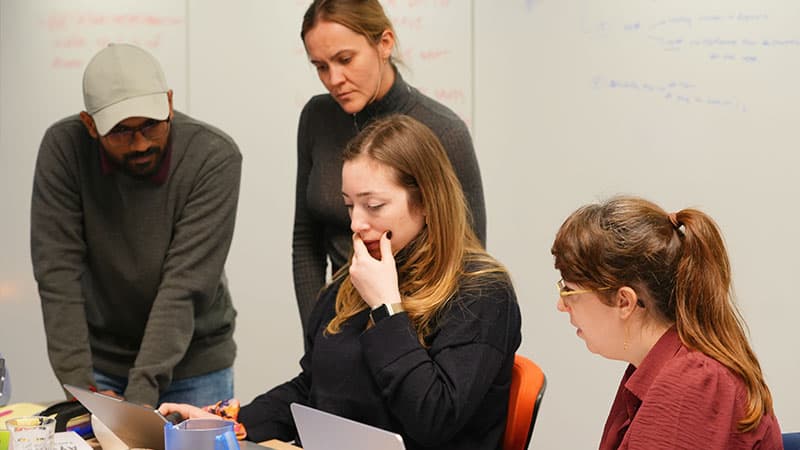
A good hackathon has energy; a great one has impact, with better questions, clearer thinking and outputs that people can and want to use on the factory floor. That’s what happened when our full-time MBA students teamed up with NLMK Europe for a first GenAI hackathon, which was built around a reality every industrial site recognises: maintenance teams don’t lack data, they lack time. “Production data sounds structured in a classroom but in reality they’re not,” says Martin Butler, Professor of Management Practice in Digital Transformation, who helped shape the business case. “A combination of human and machine capturing leads to missing elements, language inconsistencies and different levels of detail.” Together with Vladimir Vashurkin, Smart Manufacturing Lead at NLMK Europe, Martin brought a live operational context into the classroom. “The students didn’t get a polished sandbox. They got real data and a real persona to step into… and one afternoon to make sense of it all.”
What lies behind ‘maintenance’?
If you’ve never seen reliability engineers at work, it’s easy to assume predictive maintenance begins with a deterministic model: if this, then that. NLMK’s reality, like all complex operational environments, starts with interpretation. Vladimir explains the routine: “Shift reports from production, logs from maintenance, system history, planned work still pending, streams to the maintenance team that needs to match plain-language descriptions to the correct equipment identifiers. This matching stage accounts for 40-50% of the daily workload, which is huge. That’s why the goal of the hackathon was to speed up the daily routine with the help of AI. Not ‘AI for AI’s sake’, but a first step towards an AI agent that can support the people doing the work.”
A brief that became part of the learning process
MBA students fully engage when a case is credible. For Martin, that was non-negotiable: “NLMK provided current, unstructured data from the previous month and maintenance engineers to explain the context.”
Even before the hackathon started, the collaboration created value through clarity. Vladimir smiles when he recalls the weeks when he and his team of project sponsors, together with Martin, worked towards the kick-off of the hackathon: “It was funny, actually. We expected to have the relevant data at our fingertips, but we found ourselves faced with the ambiguity – and harsh reality – of data. It was not always clear how the reports were named, which teams had generated them and what the data source was, because data are generated through different channels.”
One afternoon, six teams, multiple ways in
On the day itself, the room looked and sounded exactly as you would expect at a hackathon: teams clustered together, questions flying around and context being tested. And as Vladimir explains, NLMK didn’t hide behind a slide deck. “Three colleagues and I were there the whole afternoon to answer any questions the students might have. We gave them absolute freedom in how they approached the problem. But to keep the output accessible, we insisted they use Microsoft Copilot as their main AI tool, although they could use other tools if they wanted to.”
What mattered most was the thought process. Groups needed to break down the maintenance persona’s routine into steps and then translating those steps into a prompt flow that created usable outputs. “That openness gave way to variety,” Vladimir points out. “Out of those six groups, we saw very different approaches. Some started top-down, by grouping, structuring and dashboarding, before moving on to insights. Others started by mapping the environment first.”
The student experience: diverse teams, real energy
For the full-time MBA cohort, the hackathon is part of a broader immersive AI learning journey that is deliberately woven into disciplines rather than being treated as a standalone topic. “We don’t teach a course on AI,” says Martin, “we develop AI-skills within the practical applications within disciplines and real applications.”
The build-up to the hackathon was light but intentional. “A few teaser emails beforehand, with a playful invitation to wear hoodies like real hackers, and some general information on how operations work at NLMK,” recalls Carole Govaerts. Together with Antonio Vasco de Mello and three other fellow students, she was part of one of six diverse groups that entered the arena. “I have a legal background myself, and the rest of our team combined engineering, finance and marketing/politics.” Antonio brought an engineering and maintenance background to the table, “albeit from the very different context of offshore vessels. AI hadn’t been part of my work because we weren’t allowed to use it due to confidentiality concerns. So no, it’s not as if we had an AI wizard in our team.”
‘Good’ output
Rather than starting with a model, the team’s first move was not to open a model, but to open a conversation with NLMK’s engineers. “We asked them what really slows them down,” says Antonio. “Downtime isn’t just one thing; it’s hundreds of small decisions made under time pressure. We needed to understand what they look at when something goes wrong.”
Carole explains how they structured the bulk of data: “We identified which fields were actually useful and made sense of the different data sources and methods of capturing. Then we translated this into a prompt structure that engineers can reuse.”
In practice, their prototype combined several data sources into one flow. The user selects a machine and a time window, and the AI-assistant returns a clear summary of anomalies, likely root causes, and recommended checks, always with references to the underlying log lines. “Our deliverable was simple and modular,” Antonio adds. “We proposed a ‘prompt library’ and a dashboard flow that can grow with the data, starting with one line or one machine, then expanding. This makes it realistic to pilot.”
Next steps
For Vladimir, that practicality is the whole point – and the reason why Carole and Antonio’s team won. “We plan to take the hackathon output back into the organisation, review the concept with additional maintenance experts, stress-test it on more equipment and time windows, and clarify what data work is needed to move from concept to pilot.”
The hackathon may also signal the beginning of a longer collaboration. NLMK Europe and Vlerick are exploring a possible follow-up in the form of an In-Company Project. A small student team could help mature the solution by tightening up the prompt framework, improving the dashboard logic, and translating it into a roadmap for implementation.
Martin underlines the balance that makes partnerships like these work: “NLMK must see business value, students must see learning.”
Vladimir’s lessons learned
|
Get in touch!

Maaike van Ameijde
Manager Learning Hub