
One AI strategy – four different games



By Andreas Munzel
Professor of Marketing
Your leaders probably all agree that they need an AI strategy. But are they playing the same game when it comes to designing and implementing it? New research reveals four distinct approaches to AI – and why it’s critical that leaders understand the differences.
Imagine four managers sitting around a table, discussing their organisation's AI strategy. Everyone agrees AI is important. It has potential. The organisation needs to embrace it. So far, so good.
But what happens when they leave the meeting?

Key takeaways
Leaders may support the same AI strategy while approaching its implementation differently.
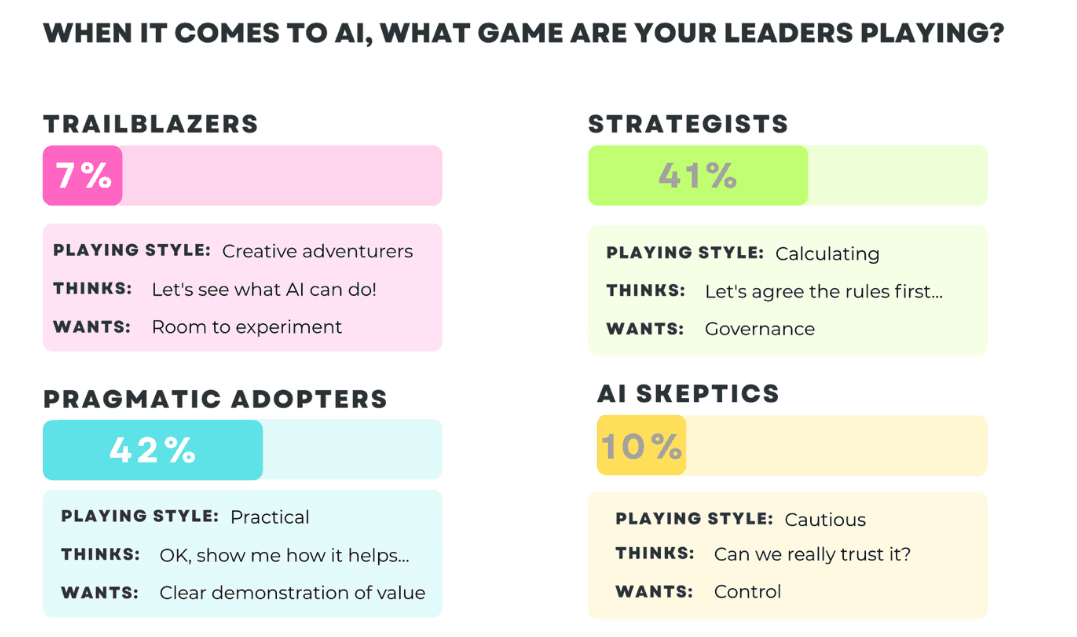
Trailblazers (7%), Strategists (41%), Pragmatic Adopters (42%) and Skeptics (10%).
Leaders’ perceptions and working environments also factor into how they use and deploy AI.
Leaders should recognise different ways of playing the AI game, tailor their support and harness the strengths of each approach. |
One starts exploring how AI could transform strategic decisions. Another wants clear governance before making changes. A third uses AI to make everyday tasks quicker and easier. And the fourth? They're still not convinced it's worth the trouble.
Unless leaders recognise these different relationships with AI, they could find themselves with four very different approaches to putting a top-level strategy into practice.
Meet the four players
New research by Grzegorz Leszczyński, Piotr Gaczek and Vlerick’s Professor Andreas Munzel identifies four distinct ways that leaders approach working with AI.
Based on a study of US marketing managers, the researchers found that professionals differ not just in how much they use AI, but in the role they believe it should play in their work.
- AI Trailblazers (7%): The game changers
For these leaders, AI is more than a useful tool. It's a strategic partner. They're comfortable exploring new possibilities, integrating AI across activities and giving it a greater role in decision-making.
- AI Strategists (41%): The calculated players
They're enthusiastic about AI's potential, but want to stay firmly in control. They favour structured adoption, clear governance and human oversight. Innovation? Absolutely. But with rules.
- Pragmatic Adopters (42%): The practical players
These leaders aren't looking to reinvent the organisation. They want AI to help them get things done. Think faster analysis, greater efficiency and a useful second pair of eyes. Human judgement stays in charge.
- AI Skeptics (10%): The reluctant players
They see fewer benefits and more reasons for caution. Questions about trust, transparency and the potential erosion of human creativity and judgement make them hesitant to embrace AI.
Different games, different outcomes?
Imagine asking these four managers to put the same AI strategy into practice.
The Trailblazer might push for AI to take on a bigger role in strategic decisions. The Strategist might develop approval processes and governance frameworks. The Pragmatic Adopter might introduce tools that save their team a few hours each week. And the Skeptic might carry on very much like before.
All four could believe they're acting responsibly. But their approaches to AI adoption, decision-making and risk could look very different.
Environment and perceptions matter too
There's another interesting finding. The researchers discovered that leaders’ attitudes towards AI were closely associated with how much control they felt they had over it – and how well they believed they understood it. Trailblazers scored highest on both measures. Skeptics scored lowest.
Working environment matters too. Trailblazers tended to work in organisations that encouraged AI experimentation, while Skeptics reported the least supportive environments.
For all these reasons, the research argues that organisations need to move beyond a one-size-fits-all approach to AI adoption – tailoring interventions and rollout approaches to specific organisational and attitudinal needs.
This could mean giving Trailblazers opportunities to champion innovation, providing Strategists with structured learning and clear governance, showing Pragmatic Adopters the practical benefits, and helping Skeptics build confidence through supported experimentation.
Critically, the aim isn't necessarily to turn everyone into a Trailblazer. Different approaches can bring different strengths. Enthusiasm can drive innovation, while caution can help organisations avoid costly mistakes.
The challenge for leaders is to recognise the differences, provide the right support and establish shared expectations about AI's role in the organisation.
Getting everyone to agree that AI matters is the easy part. The real challenge is making sure their different playing styles contribute to the same goal.
Curious of getting to know more about this topic, check out our open programmes on Digital Marketing & AI and Digital Strategy & AI.