
“The first step is the hardest. Why wouldn’t you opt for more support?”


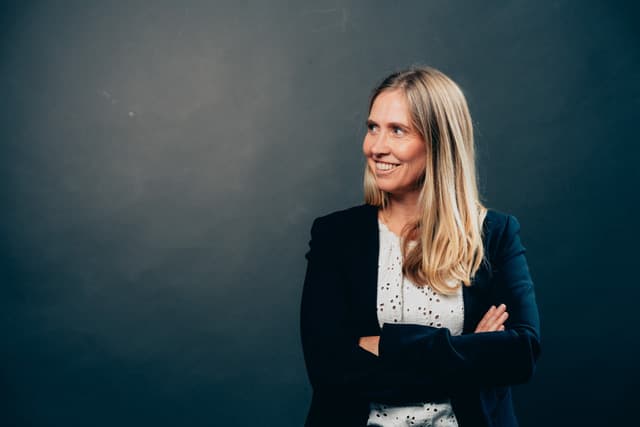
Audiovisual storyteller Griet Vanhemel has a dream: a computer game that is not based on competitiveness, but instead brings greater calm and connectedness into families. With help from the Challenge Bootcamp, she successfully embarked upon the complex journey to funding. “All the different elements were there in my head; I just needed help presenting them in a structured manner.”
About Studio GROA
- Founded in 2024 by audiovisual storyteller Griet Vanhemel and her partner Joachim Vleminckx, the creative director at Larian Studios.
- Research and development company in gaming technology, with a focus on human technology: technology based on human values such as empathy and relationships.
- First project: a family game about recognising and acknowledging emotions.
- Team of 7 freelancers.
Why did you choose the Challenge Bootcamp?
“For my graduation project, I developed an animation series for children. Then I created audiovisual concepts for companies, and worked in IT and education, but I always had the dream of entrepreneurship at the back of my mind. There was even an idea there, something that had grown out of a need I experienced myself as the mother of two daughters: to develop a game that parents can play with their children, which isn’t about being the best but about rewarding emotional intelligence. In 2024, things suddenly started moving fast. Larian Studios, the gaming company where my partner works as a creative director, had won Game of the Year with Baldur’s Gate 3. That gave us the financial capacity to set up a management firm together, so that I could get to work on my dream. Not long afterwards, we were selected for VLAIO’s innovative starter support, a support process in which you get a sum of money to develop a clear business case. That involves testing whether there is a market, developing a sustainable business model, drawing up a strategic roadmap, etc. That last point in particular was something I wanted help with. There was so much in my head, but I needed points of reference: how could I tackle this in a structured, well-founded way?”
What are the main insights you gained from the training programme? Have they helped to resolve your challenges?
“Unsurprisingly, the lessons about pitching or go-to-market strategies were the ones that stuck, because we’re still in the start-up phase. For example, I found that the simple but valuable piece of advice that ‘people don’t care what’s going on behind the scenes’ was worth its weight in gold. Many course participants, myself included, presented our companies from our own perspectives: what we wanted to do, what we’d already done and so on. But you sell food in a restaurant with flavours, not by explaining how it’s made. In the same way, every good pitch starts with a customer experience. I sort of knew that already – the audiovisual sector is all about the experience – but getting this advice made me give it more thought.
The tip that you should make things as easy as possible for your customer, that convenience really is key, is also something I’ve taken to heart. It needs to feel effortless, the way a subscription to meal kits feels to the right target group.”
Besides this practical advice, we learned a lot about management. This included things like the Business Model Canvas and the Pimento Map: tools I’d already encountered at VLAIO, but more superficially. In the Challenge Bootcamp, we really took a deep dive. We were given a green booklet full of specific questions, which is exactly what I needed. I keep it in my bag, and if I have a free moment, I open it and try to answer a new question.”
How have you implemented these insights?
“Now we’re in the phase of presenting our idea to our target audience, in schools for instance. It’s still challenging, but we are making inroads by focusing on convenience: for example, we invite parents to join us in the early afternoon and provide a free lunch. Our presentations genuinely begin with their experience. For example, lots of people have bought a PlayStation but haven’t found many family games, if any. We want to meet that need with a game you can play together, and one that connects families, rather than games that make your children shut themselves off from you or get frustrated.
In terms of business, I often hark back to the tools offered for writing my proof of business and proof of concept for VLAIO. Take the green booklet: it contains specific questions such as ‘what is your value proposition?’, ‘what funding needs do you have?’ or ‘what people do you require for a complete team?’. This is a great help in making our strategy roadmap concrete.”
What impact has this had on your business?
“We officially started in January 2025. The support from VLAIO enabled us to bring together a team of freelancers who are helping us to develop a prototype. We will use that to apply for funding from the Vlaams Audiovisueel Fonds. In the meantime, I’m also working on deliverables for VLAIO. I can’t present any results in terms of revenue or profits, because we’re simply not in that phase yet. Honestly? That’s why I was unsure whether to do the Challenge Bootcamp. We haven’t got all that far yet; it’s still a project, not a company. But that was exactly what made it a good investment. In entrepreneurship, the first step is the hardest. Everything is vague, uncertain and intimidating. You don’t know what to do first, you have to manage people who are more experienced than you, you need to have difficult conversations, and so on. The Challenge Bootcamp made things clearer. I understand my accountant better. I know I’m capable of good leadership as long as I stay true to myself and know which steps I need to take. The presentation to the jury at the end of the programme gave me a stronger sense that my idea was a good one, and it even generated a few valuable connections for my advisory board. It turned out to be the perfect programme for this phase of our business.”